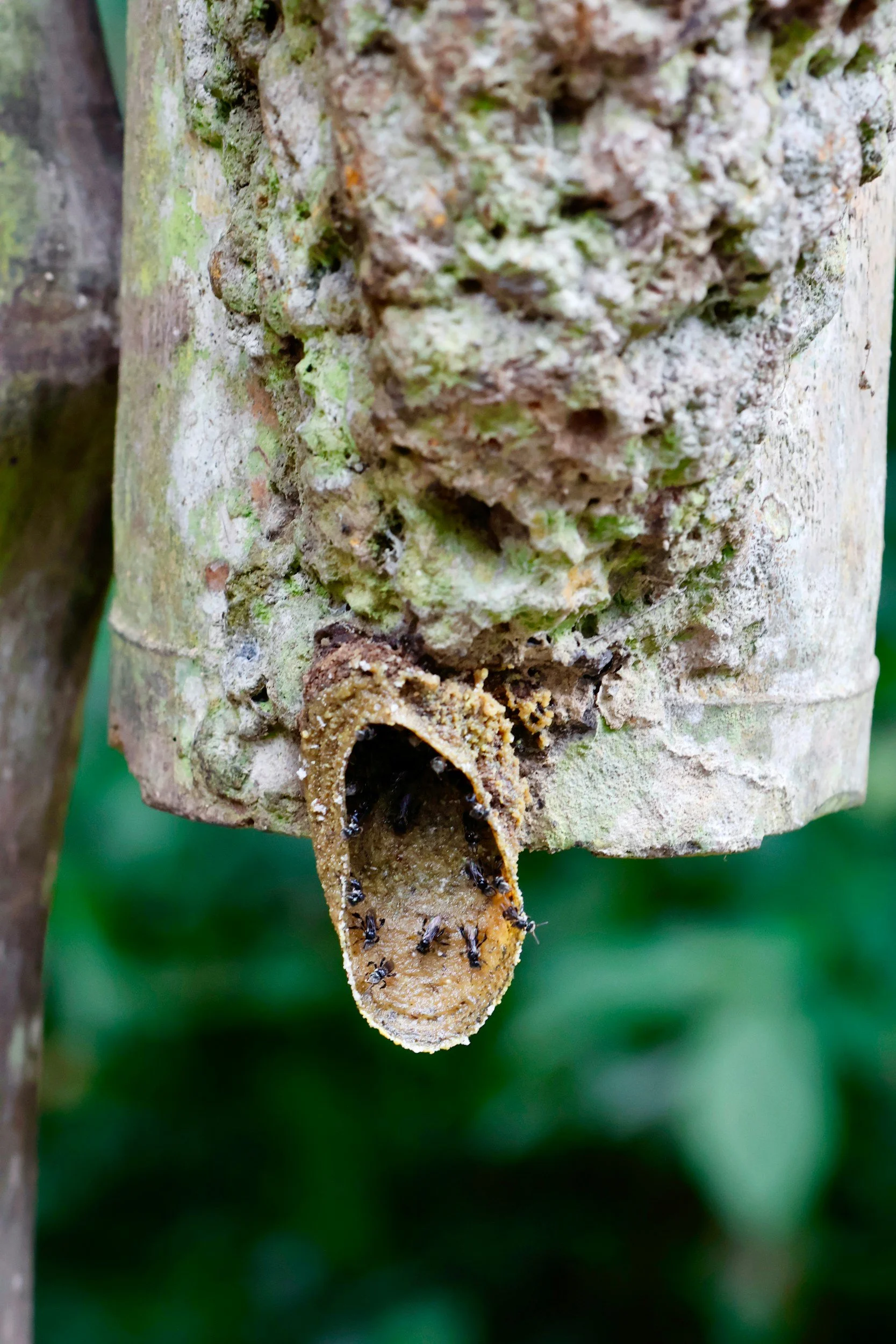
We all love our bees, but do you know in Australia we have our own indigenous bee’s species as well?
When we talk about bees, we often think of European honeybees, the primary producers of honey for human consumption. But here in Australia we also have many native bee species that produce honey. On this continent, the bees we commonly find are stingless bees, a diverse group distinct from the familiar European bees. It is estimated there are around 1,600 species of these native bees across Australia. As their name suggests, they are stingless, making them gentle pollinators and valuable members of our ecosystems.
Stingless bees belong to the Tetragonula genus; compared to European honey bees, they are tiny, shiny black little bees. They form an important army of pollinators, quietly working to fertilise our native flora. These native bees thrive across tropical to sub‑tropical regions, from Queensland down into parts of southern New South Wales. Not only do they pollinate our native plants, they also produce honey like their European relatives, though in much smaller quantities each year. Sadly, for those of us in the cooler southern areas, keeping stingless bees in a backyard is usually not feasible — the low temperatures can be too harsh for them to survive, and even if a colony persisted through winter, we could not ethically harvest their honey, as the bees need every drop to make it through the cold months.
To keep stingless bees, it’s best to leave them in their natural log homes whenever possible — these delicate little creatures often weaken when moved into a commercial box. That said, a commercial hive can still be a useful option for keeping stingless bees if handled with care. Ensure plenty of native flowers grow within about 100 metres of the hive to provide abundant forage. Place the hive in a warm spot that receives gentle morning sun but is sheltered from harsh afternoon heat, and provide a nearby water source during hot seasons. Seal any gaps to protect the colony from predators or parasites that might try to enter or lay eggs; even a strong colony can be stressed by repeated attacks, so simple protective measures are wise.
Our native bees produce honey, though only in small amounts — typically less than a litre a year. This precious honey is known as sugarbag, prized for its super-sweet, tangy flavour derived from the nectar of our eucalyptus trees. Small-batch and full of native character, the honey from our bees is also available online if you’d like to try a jar.